


What Are Virtual Sports?
Virtual sports are computer-generated sporting events you can bet on, which include simulated football matches, horse races, and greyhound races. Unlike real sports betting, software generates the outcome of events according to predefined probabilities, and the on-screen event then presents that result.
In these events, return rates, house edge, and betting options, as well as visuals and animations, vary by provider. Since they are virtual events with computer-generated outcomes, previous results, team form, and real-world statistics do not influence what happens next.
A Quick Overview on Virtual Sports
Question | Answer |
What are virtual sports? | Computer-generated sporting events that you can bet on. |
Are they real matches? | No, they’re RNG-based. |
How is the result decided? | Software, following predefined probabilities set by the developer. |
Can you bet on them? | Where the operator is licensed to offer them, or in countries that don’t have betting restrictions. |
Do previous results matter? | No, each result is calculated based on set odds. |
Do they run 24/7? | Yes, you will always be able to find and bet on virtual events. |
Can you predict outcomes reliably? | No. They function similarly to online casino games. |
Is there a house edge? | Yes, and it’s fixed, just like it is in a slot machine. |
Casinos typically group virtual sports by category, such as virtual football, virtual tennis, virtual basketball, and virtual racing. Within virtual football, for example, you can bet on simulated leagues styled to resemble real ones, though the teams and players are not real people or clubs.
How Does Virtual Sports Betting Work?
Virtual sports betting works very similarly to how real sports betting works, even if the way outcomes are decided is very different:
Choose an event or sport from the operator's virtual sports section, which can be found in the sportsbook (if there’s one) or in the site’s casino lobby.
Watch the on-screen simulation. It looks like a live broadcast, but remember that it is generated and not a live transmission.
Review the available markets, which appear alongside the event.
Place your stake, either before or during the event, depending on the sport that you’re betting on.
Wait for the result. Bets settle automatically once the event ends.
Many virtual sports show only highlights of a predetermined outcome rather than the full simulation, and market availability is much more narrow than in traditional sports betting since there are no real players. Prop betting isn’t a thing in these events.
How Are Virtual Sports Results Generated?
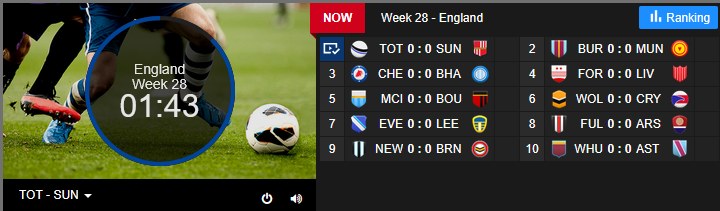
In RNG-based virtual sports, the software determines the outcome before the animations appear on your screen. The animations, videos, and graphics showcase results that have already been determined. Generally, as soon as the event begins, the outcome is calculated. You just watch it for immersive purposes.
Each event is independent, which means that nothing that happened in a previous race or match changes the probabilities of the next one.
Odds and Margin
Displayed odds reflect the relative probabilities assigned to each outcome, with the operator's margin, known as the overround, built into them. You can estimate that margin yourself: convert each outcome's decimal odds to an implied probability (1 divided by the odds), then add the implied probabilities together. In a three-way football market, home plus draw plus away should sum to roughly 100% if there were no margin. Anything above 100% represents the overround.
 Casino Wizard Tip
Event Frequency
In the virtual sports products we reviewed, football, basketball, and tennis events typically took between 3 to 5 minutes, offering “live” betting within the events.
Racing events moved faster than football or basketball, though. New races start roughly every couple of minutes and betting only open between races. Different providers can change their games’ pacing, but you’ll notice that it’s very similar between studios anyway.
RTP and House Edge in Virtual Sports
RTP stands for “return to player”, which is the theoretical percentage of wagers a game is expected to pay back over a very large number of bets. A 95% RTP corresponds to a 5% house edge. That does not mean a $100 wager returns exactly $95, but it does mean that the site expects to keep around 5% of all bets placed on that specific game.
Exact RTP is generally not disclosed in virtual sports. In fact, a virtual sports game may not have one single theoretical RTP across all its bets, since return can depend on the specific market a player chooses, just like side bets in baccarat have different return rates compared to standard banker or player bets.
Main markets, such as match winner, can have lower margins than more specialized markets like correct score. You’ll find fewer options in virtual sports compared to real sports betting, but margins should still be taken into consideration.
Can You Actually Beat Virtual Sports Betting Odds?
Virtual sports are better seen as casino games rather than sports betting events, from an analytical perspective. Past results or staking systems, such as the Martingale, cannot change the probabilities of an RNG game or remove its margin, just like it happens in a slot game.
What you can do, however, is take the same elements into consideration that you would take when choosing or playing a casino game:
- Manage your bankroll, since events resolve every couple of minutes, which can lead to quick betting turnovers.
- Bet flat stakes rather than raising them after a loss to prevent loss chasing.
- Compare RTP across similar markets where the operator discloses it, if you are able to find them, since most of these games don’t disclose it.
Unlike in real sports, following recent winners, betting on a team because it "won five in a row," pattern bets, and using real-world team statistics just doesn’t work. Value betting is not present in virtual sports.
What Virtual Sports Can You Bet On?
Virtual sports is most commonly represented in the football world, where you’ll find simulations of popular European leagues and international teams, albeit with different names to avoid copyright issues. These are the main events that you’ll be able to bet on if you decide to partake in virtual sports betting:
- Virtual football: match winner, draw, double chance, over/under, both teams to score, correct score.
- Virtual horse and greyhound racing: winner, place, forecast (predicting the first two finishers in order), tricast (predicting the first three finishers in order), and exact order markets, whose exact combinations depend on the operator's rules.
- Other formats: tennis, basketball, motor racing, cycling, and cricket, availability depending on the provider and operator.
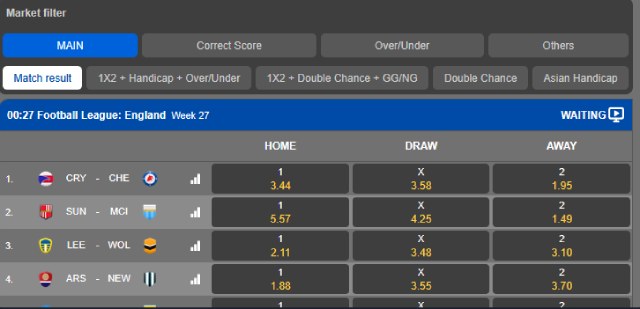
This is the "England Football League", which references Premier League teams.
The Differences Between Virtual Sports vs Real Sports Betting
Virtual sports aims to emulate real sports betting, but its “computer-generated” essence makes both types of betting fundamentally different from one another. These are the main differences between both:
Feature | Virtual Sports | Real Sports |
Outcome | Software-generated, based on RNGs. | Real-world result that depends on human performance. |
Events available | Usually 24/7. They start over after they end. | Scheduled, following a calendar. |
Research | Doesn’t really matter beyond in-game results | Can influence analysis and positively affect chances of wins. |
Weather, injuries, form | Irrelevant, as none of these play a part in virtual games. | Can cause significant changes to potential outcomes. |
Speed | Events rarely last longer than 5 minutes, as they’re presented in a highlight-style format. | They rarely last fewer than an hour. |
House edge | Built into the game and calculated statistically. | Calculated into bookmaker odds. |
Sports knowledge has little application to virtual sports. Odds still show which outcome is favored, but past results, injuries, and tactics do not influence anything, since outcomes are generated by a computer.
Why Virtual Sports and eSports Are not the Same
Virtual sports are computer-generated events with results determined by software and RNG systems. eSports are real competitive video game events involving human players or teams. Since eSports involve real competitors, analyzing recent performance, roster changes, and tournament history can inform an eSports bet the way it does not for virtual sports.
Many sportsbooks offer markets for both, but they’re usually kept separate: virtual sports typically sit within a casino section, while eSports appear alongside traditional sportsbook markets. Some sites combine both, though.
Casino Wizard Tip
The Main Studios Behind Virtual Sports Betting
There aren’t as many virtual sports studios as there are casino game developers, as virtual sports are much more niche than slots or table games. However, there are six main suppliers that you’ll come across in online gaming sites offering virtual sports:
Provider | Licensing detail |
Inspired | Inspired Gaming (UK) Ltd is UKGC licensed and holds an MGA recognition notice; Inspired Entertainment (Malta) Ltd separately holds an MGA Critical Gaming Supply licence. |
Kiron Interactive | Holds a UKGC remote gambling software licence and a General Betting Standard – Virtual Event Remote licence. |
LEAP Gaming | Holds an MGA B2B Critical Supply (Type 1) authorisation and a UKGC authorisation. |
GoldenRace | Group companies operate under MGA Corporate B2B licence MGA/CRP/320/2016; Softquo Holding Ltd is UKGC licensed. |
Vermantia | Operates virtual sports content in Romania and is one of the studios known to develop virtual sports. |
1x2 Network | Holds a Malta licence and stands out as a complete software provider that also develops online slots. |
Are Virtual Sports Legit?
Virtual sports events hosted by licensed and tested studios are fair, but results are RNG-based, like in a casino game rather than in a sports betting event.
You should always check the casino’s own licence, the software supplier's licence or authorisation, and any independent testing or certification of the game itself. In regulated markets, such as the UK’s, virtual sports suppliers must meet testing and technical requirements set by the regulators that license them, but requirements vary by jurisdiction, so one licence doesn’t necessarily mean that the site is legal elsewhere.
Before playing, you should check:
- The operator's licence and its validity.
- The software provider that created the game.
- The game rules, which can be found after booting the title of your choosing.
- Any disclosed RTP information, if there is any.
You should also look into the site offering the games to ensure that the platform is legit. The options that we recommend at The Casino Wizard have been tested by our team, which you can verify by reading our casino reviews.
Where Can You Gamble on Virtual Sports?
There are three main elements that dictate where you can gamble on virtual sports:
- The operator’s license, which determines if the site that offers virtual sports is legal in your jurisdiction.
- An operator's willingness to accept players from a given country, as some casinos and sports betting sites willingly opt out of accepting users from certain jurisdictions.
- The legality of virtual sports betting in that player's own jurisdiction.
Remember that an offshore site that accepts a resident of a given country does not by itself establish that betting is lawful there. You should always check local rules rather than assuming a site is legal just because your country’s flag or name appears on it.
Are Virtual Sports Worth Playing?
Virtual sports tend to suit players who want events available at almost any hour, fast results, familiar sports formats, simple markets, and not depend on what happens in the real world.
However, these games tend to disappoint players who enjoy researching teams, analyzing statistics, following real competitions, or using injury and roster news to inform a bet. Since it’s a simulation, these elements don’t come into play whatsoever.
On the practical side, payouts settle automatically once an event ends, just like they would on a casino game. You can also play them on any device.
Wizard Tip: Research the name and history of virtual sports software providers before committing to their games. Since RTP rates are not disclosed, it’s better to stick to virtual sports games created by well-known, lab-tested studios like Golden Race and Leap Gaming.
Where to Bet on Virtual Sports
We’ve made a list of gaming sites that have been tested by The Casino Wizard team and that offer virtual sports betting options and markets. Virtual sports betting markets can be found either in the “casino” or “sports” section of online gambling sites, as some casinos opt to integrate them directly to their sportsbooks should they offer them.

|
300% Match Deposit + 175 Free Spins
|
Claim bonus |

|
100 Free Spins on Registration
|
Claim bonus |

|
€1,000 + 400 Free Spins
|
Claim bonus |
When we first reviewed some of the casinos that are now ranked as some of our favorite gaming options, such as mBit, 7Bit, and BitStarz, they all offered virtual sporting events. Today, these sites have excluded virtual sports betting from their casino game selections.
Always Gamble Responsibly When Betting on Virtual Sports
Virtual sports are very fast-paced, which creates short event cycles, meaning that you’ll have more frequent opportunities to place another bet. Since this can quickly translate into a large array of bets, there are a few habits help manage that:
- Establish a session limit before you start and don’t go over it. Take a break when the time ends.
- Set a fixed loss limit and stick to it even if that means that you didn’t win any money from your session.
- Avoid raising stakes after a loss, as this is a way of chasing losses that can make you lose all of your funds in minutes.
- Take breaks between sessions to prevent staying fixed to your screen for longer that advisable.
- Use the operator's deposit and loss limit tools if available. Responsible gambling tools are not present in every site, but they can be helpful to keep your gaming in check.
If you feel you need support, GamCare, GambleAware, and the National Council on Problem Gambling are worth contacting.
You pick an event, choose a market, place your stake, and the simulation plays out before settling your bet automatically.
Yes, virtual sports function much closer to casino games than to traditional sports betting, even though they're presented as sporting events.
No. They're computer-generated events with outcomes decided by an RNG rather than by real athletes.
No. eSports involve real players competing against each other. Virtual sports involve no human competitors.
With third-party virtual sports products, outcome generation is generally handled by the game and provider system rather than manually set by the casino, though the exact setup depends on the product.
It depends on your jurisdiction. In Great Britain, operators offering remote betting on virtual events need the appropriate Gambling Commission licence; elsewhere, check local rules directly rather than relying on an operator's willingness to accept you.


Your feedback has been received and will be made public after review.